Table of Contents
- The Data Pipeline Is the Bottleneck
- Which GPU to Pick for Data Science?
- The GPU-Native Data Stack
- Getting Started with RAPIDS
- What Makes a GPU Good for Data Science
- GPU Comparison Table
- How Much VRAM Do You Actually Need?
- When to Add a Second GPU
- Match the GPU to the Workflow
- EDA and Feature Engineering
- Classical ML and Small Deep Learning
- Production Pipelines and Batch Processing
- GPU vs CPU Cost Efficiency
- GPU Buying Mistakes
- BIZON Workstations for Data Science
- Picking Your Data Science GPU
What is the Best GPU for Data Science in 2026?
Last verified: May 2026. Specs and RAPIDS benchmarks confirmed against official NVIDIA sources, RAPIDS release notes, and bizon-tech.com.
GPU-accelerated tabular processing turns a 9-minute pandas wait into 1.2 seconds with no rewrites required. One import line. A pandas groupby on 100 million rows finishes before your hand leaves the mouse, and cuDF ships as a drop-in pandas replacement. The bottleneck is now memory, and the GPU pick follows.
Data science acceleration differs sharply from GPU-accelerated LLM work. Memory wins over compute here, since ETL and feature engineering bottleneck on memory bandwidth rather than tensor throughput, so VRAM ceiling and bandwidth weight ahead of TFLOPS. Polars, DuckDB, Snowflake, Databricks, and Apache Spark added GPU-native processing in recent releases. The right card maps dataset size to memory ceiling, then bandwidth to the iteration target.
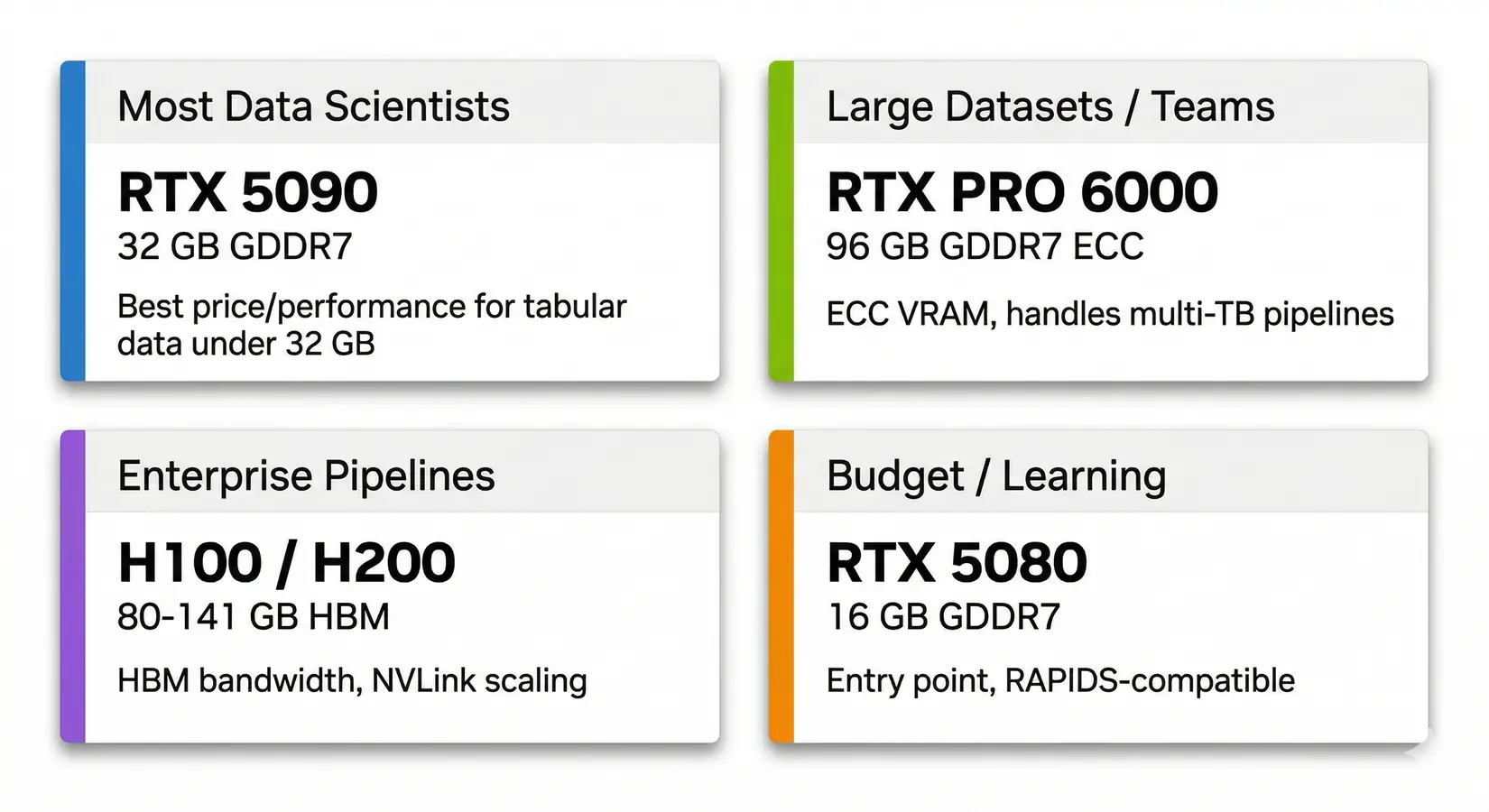
GPU recommendations by data science use case. RTX 5090 covers most professionals. PRO 6000 handles enterprise datasets.
Most data scientists spend 80% of their time on data prep, not training. The wait was unavoidable until recent release cycles, when mainstream pandas-style ETL, joins, and aggregations finally became practical to GPU-accelerate. DuckDB, Snowflake, and Databricks all announced GPU-native processing at GTC 2026. Teams that think they need an H100 often run better on a single RTX 5090. Teams that pick the 5090 to save money hit the VRAM cliff three months in and pay the upgrade cost twice. Size for data growth ahead, not last year's headcount.
Which GPU to Pick for Data Science?
The RTX 5090 with 32 GB GDDR7 is the best GPU for most data scientists. Bandwidth, not TFLOPS, makes the difference. The 1,792 GB/s covers tabular pipelines, classical ML, and small deep learning. Teams that hit the 32 GB ceiling step up to the RTX PRO 6000 for ECC and 96 GB. Enterprise pipelines land on the H100 or H200 for HBM bandwidth and NVLink.
| Use Case | GPU | VRAM | Why |
|---|---|---|---|
| Most data scientists | RTX 5090 | 32 GB GDDR7 | Best price/performance for tabular data under 32 GB |
| Large datasets / teams | RTX PRO 6000 | 96 GB GDDR7 ECC | ECC VRAM handles multi-TB pipelines |
| Enterprise pipelines | H100 / H200 | 80-141 GB HBM | HBM bandwidth and NVLink scaling |
| Budget / learning | RTX 5080 | 16 GB GDDR7 | Entry point and still RAPIDS-compatible |
Key Takeaway
For most data science workloads, the RTX 5090's 32 GB GDDR7 at 1,792 GB/s is the price-performance sweet spot. Only step up to the RTX PRO 6000 (96 GB ECC) if your datasets exceed 32 GB or you need ECC VRAM for multi-TB enterprise pipelines.
Library choice drives the real-world performance delta between a fast GPU and one that runs slow software on the wrong stack. RAPIDS, Polars, and PyTorch moved core operations onto GPU memory recently. The same card runs much faster on the right stack. Stack selection matters before GPU selection.
The GPU-Native Data Stack
NVIDIA's RAPIDS 26.02 release notes document dramatic acceleration across tabular operations. The library is a drop-in pandas replacement that runs existing code on GPU memory without rewrites. cuDF.pandas auto-routes to the GPU when supported and falls back to CPU when not, keeping partially-supported workloads running. The table below shows those benchmark speedups.
| Operation | Your existing code | Pandas (CPU) | cuDF (GPU) | Speedup |
|---|---|---|---|---|
| Switch libraries | import cudf as pd | Done | Done | One line |
| GroupBy (100M rows) | df.groupby("col").agg(...) | 47 sec | 1.2 sec | 39x |
| Join / Merge (5 GB) | df.merge(df2, on="key") | 267 sec | 1 sec | 267x |
| Advanced GroupBy | df.groupby().transform(...) | Baseline | 137x faster | 137x |
| K-Means / Random Forest | KMeans().fit(X) | Baseline (scikit-learn) | 100x+ faster (cuML) | 100x+ |
| Parquet read (Blackwell) | pd.read_parquet("file.parquet") | Baseline | 35% faster end-to-end | +35% |
Methodology. Code is identical between pandas and cuDF. Figures are benchmarked on an RTX 5090 against pandas 2.x per NVIDIA's documented methodology, reflecting NVIDIA-published and internally reproduced workloads under GPU-friendly operations. Speedups vary substantially with data shape, cardinality, storage layer, CPU bottlenecks, unsupported operations, and host-to-device transfer overhead. Parquet speedup requires Blackwell hardware. RAPIDS runs on Volta or newer.
cuML brings the same acceleration to machine learning. Random Forest, K-Means, and K-Nearest Neighbors see 100x or greater speedups versus scikit-learn at scale, with most other algorithms landing in the 3-27x range. Per NVIDIA's RAPIDS case studies, Nestle reported roughly 5x faster data pipelines after migrating ETL to cuDF, and Snap cut compute costs by 76%. Gains depend on workload fit.
Getting Started with RAPIDS
Install cuDF with pip and add two lines to your script. Existing pandas code then runs on GPU memory with no rewrites. Most teams hit a snag on CUDA driver mismatches, not on the cuDF install itself. The screenshot below shows the 100M-row groupby speedup after the two-line change.
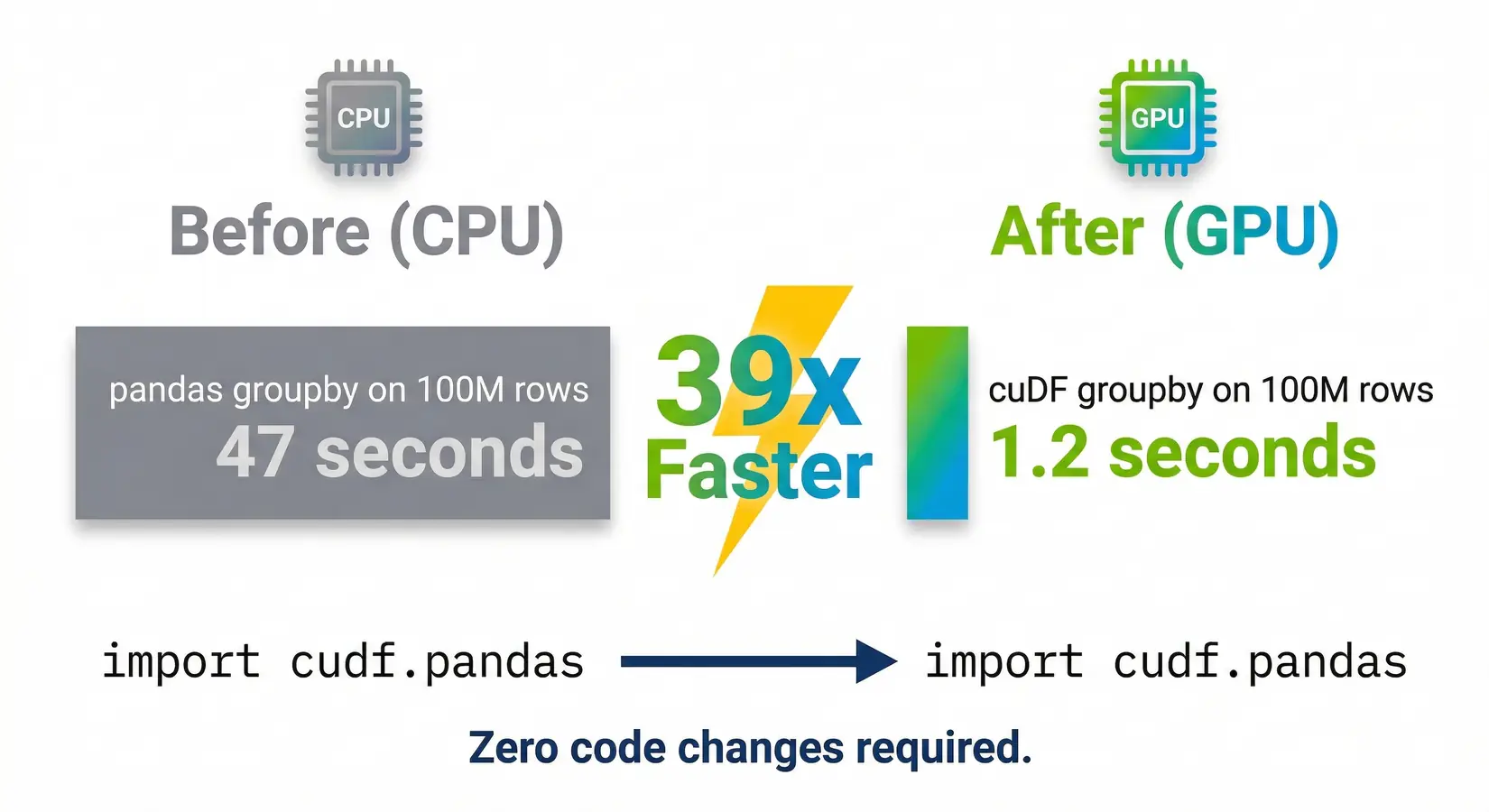
39x faster with zero code changes. A 100M row groupby in pandas (47 seconds) vs cuDF (1.2 seconds).
Krish Naik on cuDF and RAPIDS for pandas acceleration. Krish Naik channel.
Run pip install cudf-cu12 to get cuDF, then add %load_ext cudf.pandas and import pandas as pd. Google Colab has cuDF pre-installed on GPU instances, so you can validate the speedup before buying hardware. On a BIZON workstation, CUDA is pre-installed and factory-matched to the GPU, skipping the driver-debug step. Once cuDF loads, ETL, joins, and aggregations run against VRAM bandwidth.
What Makes a GPU Good for Data Science
VRAM capacity and memory bandwidth matter more than TFLOPS for data science. Joins, groupbys, sorts, and rolling aggregates spend most of their cycles moving data through VRAM, not multiplying matrices. The five specs below rank against that reality. VRAM decides fit. Bandwidth decides speed.
1. VRAM capacity comes first - Your dataset needs to fit in GPU memory. If it doesn't, the operation spills to CPU over PCIe and you lose most of the advantage. VRAM is the single most important spec for RAPIDS workloads.
2. Memory bandwidth determines throughput - Once data fits in VRAM, bandwidth controls how fast the GPU processes it. Per NVIDIA's specs, the RTX 5090 and RTX PRO 6000 both run at 1,792 GB/s. The H200 pushes 4,800 GB/s with HBM3e.
3. FP16 and FP32 tensor performance matters less than you'd think - ETL and feature engineering don't use tensor cores the way neural network training does, so compute throughput ranks third on the list for most data science work, even for cuML training.
4. ECC vs non-ECC depends on your workflow - Interactive data exploration doesn't need ECC, but unattended production batch jobs where a silent bit flip could corrupt results do. The RTX PRO series includes ECC while consumer RTX does not.
5. Software compatibility is non-negotiable - RAPIDS requires Volta or newer (compute capability 7.0+, 2017 forward). Pre-Volta cards lost support in RAPIDS 24.02. Our LLM GPU guide covers multi-GPU scaling for large model training.
GPU Comparison Table
Data science GPUs span from the RTX 5080 (16 GB) to the H200 (141 GB). Memory capacity and bandwidth predict RAPIDS performance better than TFLOPS for ETL and feature engineering. The 4,800 GB/s to 960 GB/s gap between H200 and RTX 5080 explains most real-world ETL spread. Bandwidth scales linearly with dataset size.
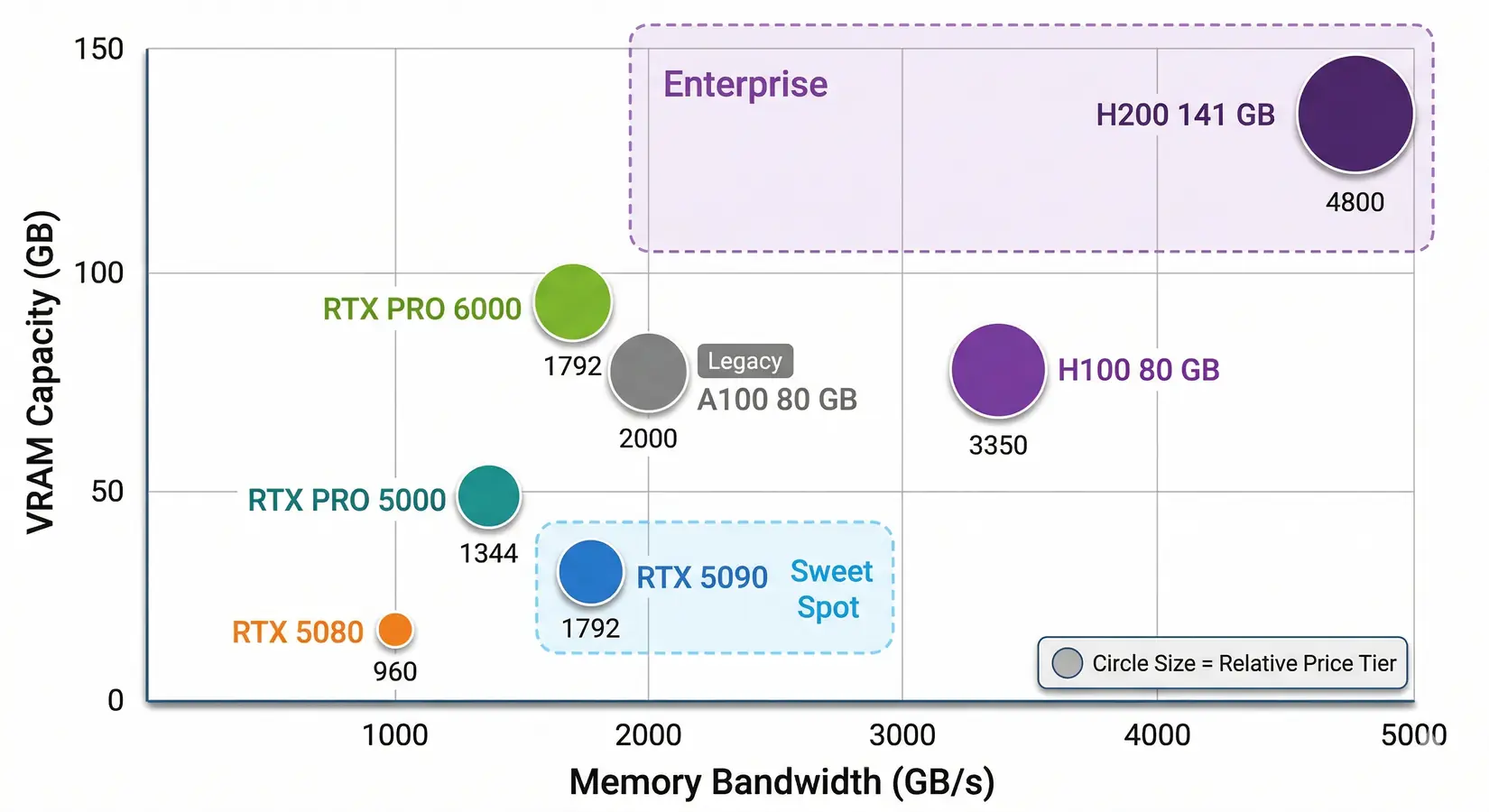
GPU options for data science. VRAM and bandwidth are the axes that matter most. The RTX 5090 sits in the sweet spot for most professionals.
Each row in the table below pairs raw FP16 TFLOPS with the two metrics that actually drive RAPIDS performance. From our build floor, single-card workstations weight VRAM heaviest, then memory bandwidth, with TFLOPS the third axis. The widest capacity-to-bandwidth gap on the table is the one most ETL pipelines feel hardest. Numbers tell the story. Use it to gauge which step-up adds real throughput versus marketing TFLOPS.
| GPU | FP16 TFLOPS (non-sparse) | VRAM | Bandwidth | Best For |
|---|---|---|---|---|
| RTX 5080 | ~113 | 16 GB GDDR7 | 960 GB/s | Budget entry, small datasets |
| RTX 5090 | ~209 | 32 GB GDDR7 | 1,792 GB/s | Best value, datasets under 32 GB |
| RTX PRO 5000 | ~130 | 48/72 GB GDDR7 ECC | 1,344 GB/s | Mid-tier professional |
| RTX PRO 6000 | ~250 | 96 GB GDDR7 ECC | 1,792 GB/s | Large datasets, ECC for production |
| A100 80 GB | ~312 | 80 GB HBM2e | ~2,000 GB/s | Still in many labs |
| H100 80 GB | ~989 | 80 GB HBM3 | 3,350 GB/s | Raw compute + NVLink scaling |
| H200 141 GB | ~989 | 141 GB HBM3e | 4,800 GB/s | Memory bandwidth king |
Methodology. FP16 TFLOPS are non-sparse Tensor Core figures from NVIDIA's official datasheets and waredb.com. VRAM and bandwidth come from NVIDIA's published spec sheets, confirmed against the BIZON catalog.
The H100 and H200 share the same compute die at ~989 TFLOPS FP16. The H200's advantage is memory: 141 GB at 4,800 GB/s versus H100's 80 GB at 3,350 GB/s. Compute is a tie. Above this tier, the B200 and B300 are LLM training cards. Our LLM GPU guide covers those workloads.
How Much VRAM Do You Actually Need?
Groupby and join operations create intermediate buffers that expand memory mid-operation, so size VRAM to roughly four times your largest DataFrame. A frame of 100 million rows and 50 float32 columns takes about 20 GB in GPU memory, fitting the RTX 5090's 32 GB with headroom. Larger frames scale predictably from there. Buy for next quarter's dataset size, not what is on disk today.
Data scientists increasingly run a local LLM alongside their data pipeline on the same GPU. A 70B model at INT4 needs roughly 35 GB of VRAM, which means running it alongside a 20 GB dataset pushes past the 5090's 32 GB ceiling. The RTX PRO 5000 (48 GB) handles that dual-use class and the RTX PRO 6000 (96 GB) leaves room for dataset growth. Budget for both workloads from the start.
The VRAM Cliff
GPU operations that exceed available VRAM crash rather than slow gradually. No gradual slowdown. RTX 5090 memory bandwidth is 1,792 GB/s versus PCIe 5.0 at 64 GB/s, a 28x gap that turns a 1-second operation into 28 seconds, slower than the CPU. Size the card to the dataset growth ahead, not what's on disk today.
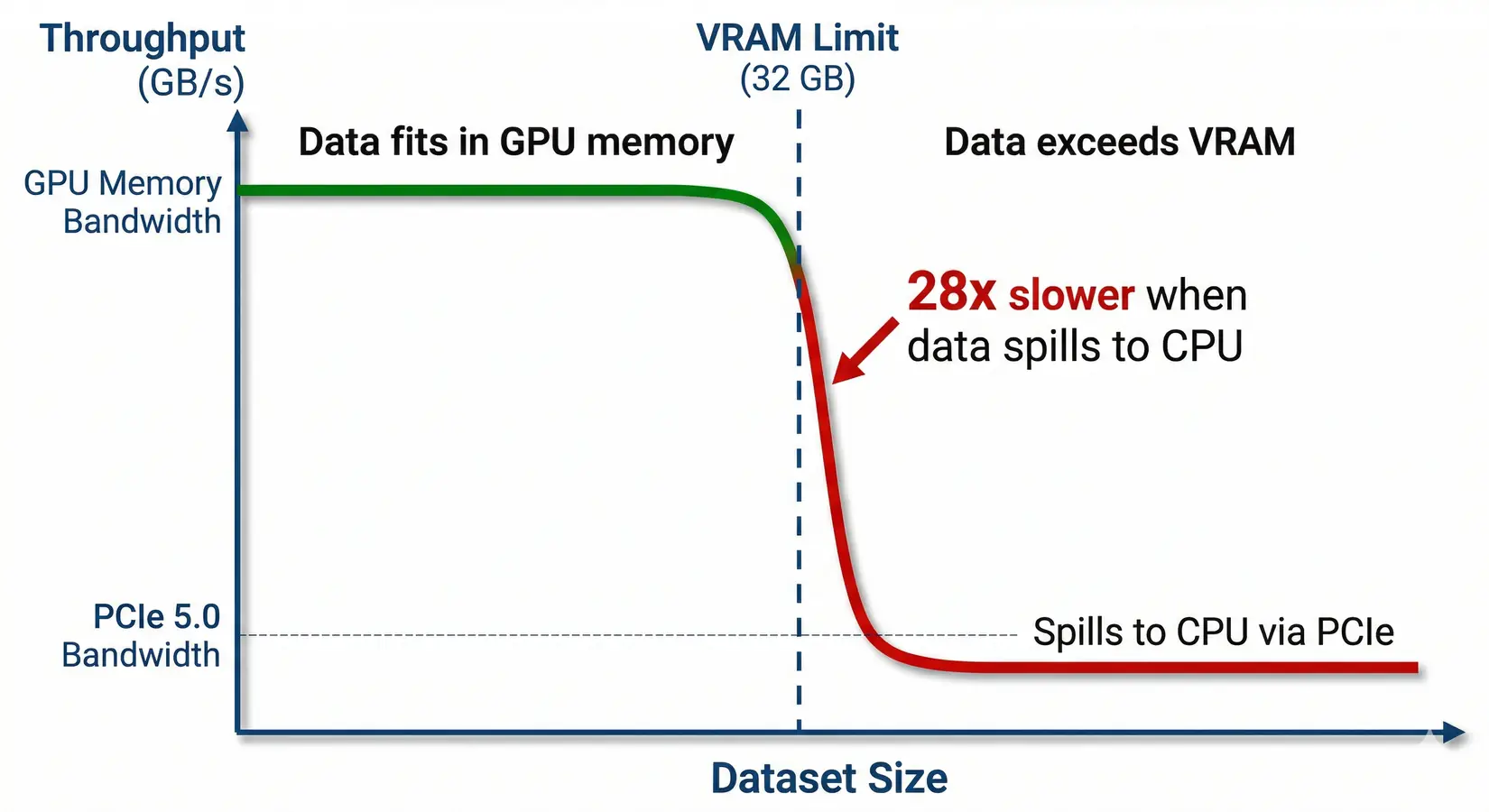
The VRAM cliff. Performance drops 28x when data spills from GPU memory to system memory over PCIe.
Watch Out
A dataset that fits a 32 GB RTX 5090 but spills to system memory over PCIe 5.0 ends up slower than running on the CPU. Always buy for 2x your current dataset size at minimum.
VRAM sizing covers most single-card workloads, but when a dataset crosses the card ceiling, the calculation shifts to multi-GPU. RAPIDS does not pool VRAM across cards by default, so a second GPU often helps less than expected on tabular workloads. A larger single card clears the memory ceiling more reliably than two smaller ones. Scale up the card first, then scale out.
When to Add a Second GPU
Most cuDF and cuML workloads run on a single GPU. One 96 GB RTX PRO 6000 outperforms two 32 GB RTX 5090s for data science because NVLink does not pool VRAM for most tabular frameworks, and each card still caps at 32 GB independently. RAPIDS assumes one device per worker, so Dask-cuDF coordination overhead on every shuffle and join often erases the throughput advantage of adding a second card. Multi-GPU wins for parallel hyperparameter sweeps, ensemble training, and Spark RAPIDS distributed workloads. Scale-out has its place.
Buy for the dataset you have next quarter, not the one you have today.
Workflow type is the second fork in the buying decision after dataset size. A pure cuDF pipeline weights VRAM and bandwidth first. A mixed pipeline handing data between RAPIDS and PyTorch needs both. Dataset size answers the VRAM question and workflow type settles the spec priority, so the card choice becomes straightforward.
Match the GPU to the Workflow
Workflow class beats team size and budget when picking the right GPU. EDA needs VRAM headroom, production pipelines require ECC memory, and ML training rewards tensor core throughput when model size justifies it. Map the workflow first, then size the silicon. The decision tree splits on dataset size first, then workload type.
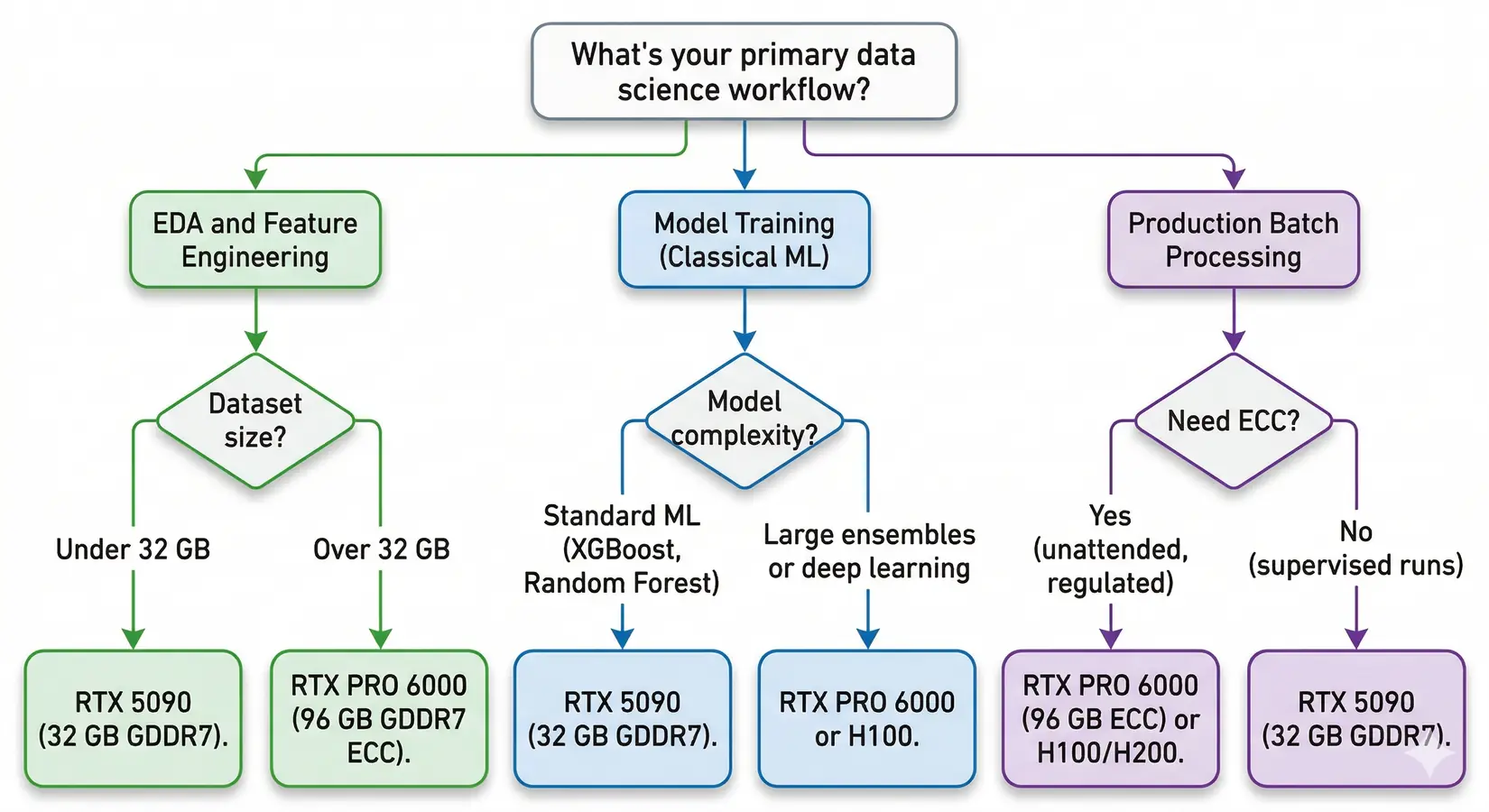
Which GPU fits your workflow? Follow the branches to find your match.
The left branch handles VRAM-limited EDA and feature engineering work, where bandwidth determines how fast the GPU can process joins, pivots, and group aggregates. The right branch covers ML training workflows, where tensor core throughput matters alongside VRAM capacity. ECC separates both from unattended production, where a silent bit flip can corrupt a run that took hours. Most data scientists start in the left branch.
EDA and Feature Engineering
This is where cuDF's pandas accelerator shines brightest. Groupby, merge, pivot, and filter operations run hundreds of times a day. VRAM caps every operation because the working dataset needs to fit in GPU memory before bandwidth can do its job. On our build floor, the RTX 5090's 32 GB handles most EDA workloads up to 100 million rows by 50 float32 columns without spilling. Size to your widest join, not your average query.
Classical ML and Small Deep Learning
cuML accelerates the models most data scientists actually use. XGBoost GPU training is now standard, and RAPIDS 25.x added out-of-core support for datasets exceeding VRAM, though spill to system memory creates latency at scale. For models up to about 3 billion parameters, the RTX 5090's 32 GB handles FP16 training. The PRO 6000's 96 GB covers larger multi-model experiments and ensemble methods without hitting the spill threshold. Threshold sizing is the discipline.
Production Pipelines and Batch Processing
Production changes the equation. ECC stops being optional once pipelines run unattended overnight or process regulatory data. A silent bit flip can corrupt results with no obvious error. The RTX PRO 6000 (96 GB ECC) and the RTX PRO 5000 (48 GB ECC) are the right tier for this class of work. In our experience configuring production pipelines, finance, healthcare, and defense teams choose local workstations because proprietary datasets cannot leave the organization under client contracts or regulatory requirements. A BIZON workstation keeps data on premises and eliminates upload latency on multi-TB datasets.
GPU vs CPU Cost Efficiency
At multiple runs per day, the time savings from GPU acceleration compound fast. Three to four hours of daily cloud GPU usage carries a monthly bill that matches the workstation cost inside a year. Faster runs mean more experiments. A faster GPU changes what experiments you run, since weekend work becomes Tuesday runs at the right throughput.
GPU Buying Mistakes
These mistakes cost data scientists thousands in wasted hardware spend. Most trace back to LLM-training instincts misapplied to a memory-bandwidth-bound workload. Know your workload class. A card chosen for tokens-per-second often underperforms on groupby because data science rewards VRAM and bandwidth, the opposite of LLM training's compute-bound profile. Read each as a buy-time veto, not a buy-time tip.
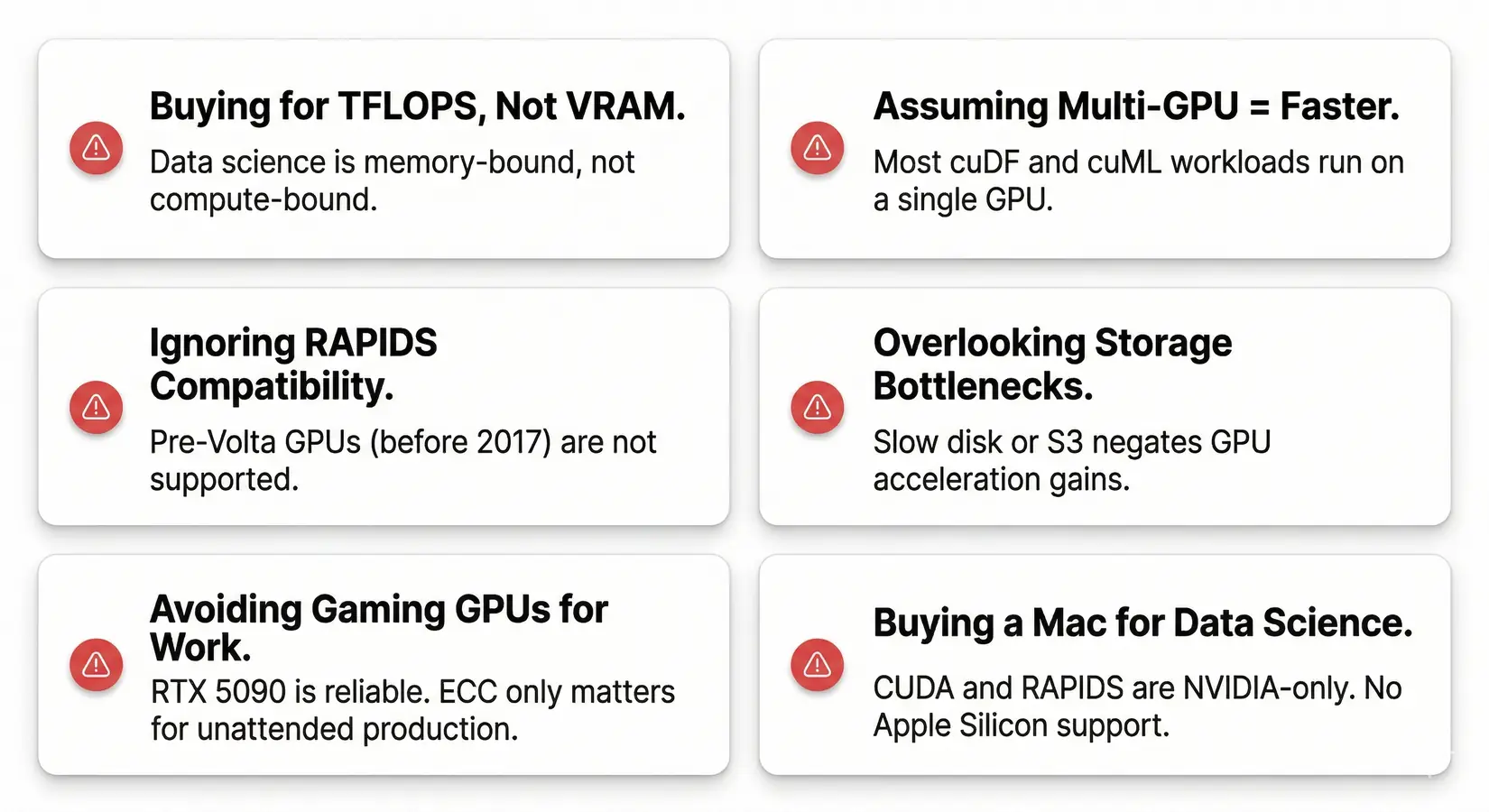
The most common GPU buying mistakes for data science. Avoid these and you'll save money and frustration.
Buying based on TFLOPS instead of VRAM - Data science is memory-bound. A GPU with massive compute but insufficient VRAM spills to CPU and loses its advantage.
Ignoring RAPIDS compatibility - Pre-Volta GPUs (before 2017) are not supported. Verify Volta generation or newer before buying used hardware.
Assuming every pandas operation is GPU-accelerated - cuDF.pandas covers most operations but not all. Custom apply functions, certain string methods, and a few exotic dtypes still fall back to CPU. Profile your pipeline before sizing for the headline 100x number.
Buying a Mac for data science - CUDA is NVIDIA-only. RAPIDS doesn't run on Apple Silicon. M-series chips are excellent for many things, but GPU-accelerated data science isn't one of them. See our Mac Studio vs NVIDIA comparison.
From our BIZON build-floor experience, a flagship card in a chassis that throttles runs slower than a tier-down card in a properly built system. PSU undersizing, inadequate cooling, and PCIe lane starvation each cap real-world throughput. BIZON builds to the GPU count and workload, not to a generic configuration. The chassis is part of the spec.
BIZON Workstations for Data Science
BIZON configurations range from dual-GPU workstations to 8-GPU water-cooled servers. Every system ships with RAPIDS, PyTorch, CUDA, and Docker pre-installed and tested on the target workload. The 3-year warranty and lifetime support cover the full stack, not just the hardware. Spec to dataset size and ECC requirement first, then pick the chassis.
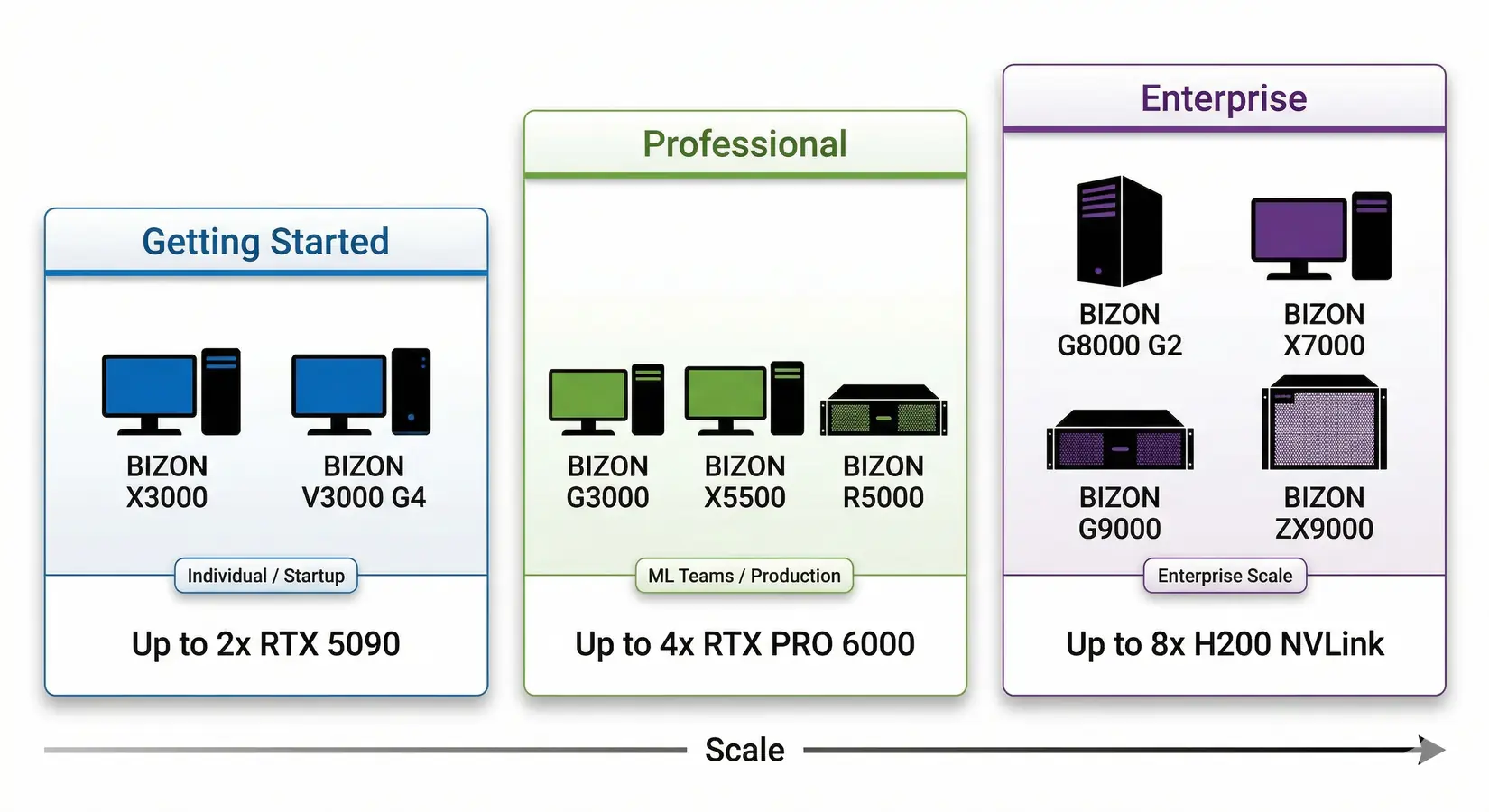
BIZON data science workstation tiers. From dual-GPU desktops to 8-GPU NVLink servers.
From the BIZON Build Floor
Water-cooled multi-GPU configurations sustain boost clocks through continuous RAPIDS workloads on paired RTX PRO 6000 cards. For teams running 24/7 ETL pipelines, that thermal headroom translates to a measurable throughput difference on the same hardware.
Dataset size splits the tier, not headcount. Entry covers datasets under 32 GB. Professional covers 32 to 200 GB with ECC memory. Enterprise covers 200 GB-plus datasets where production pipelines run continuously for days, 24/7, with no manual restarts.
Entry Tier (1-2 GPU)
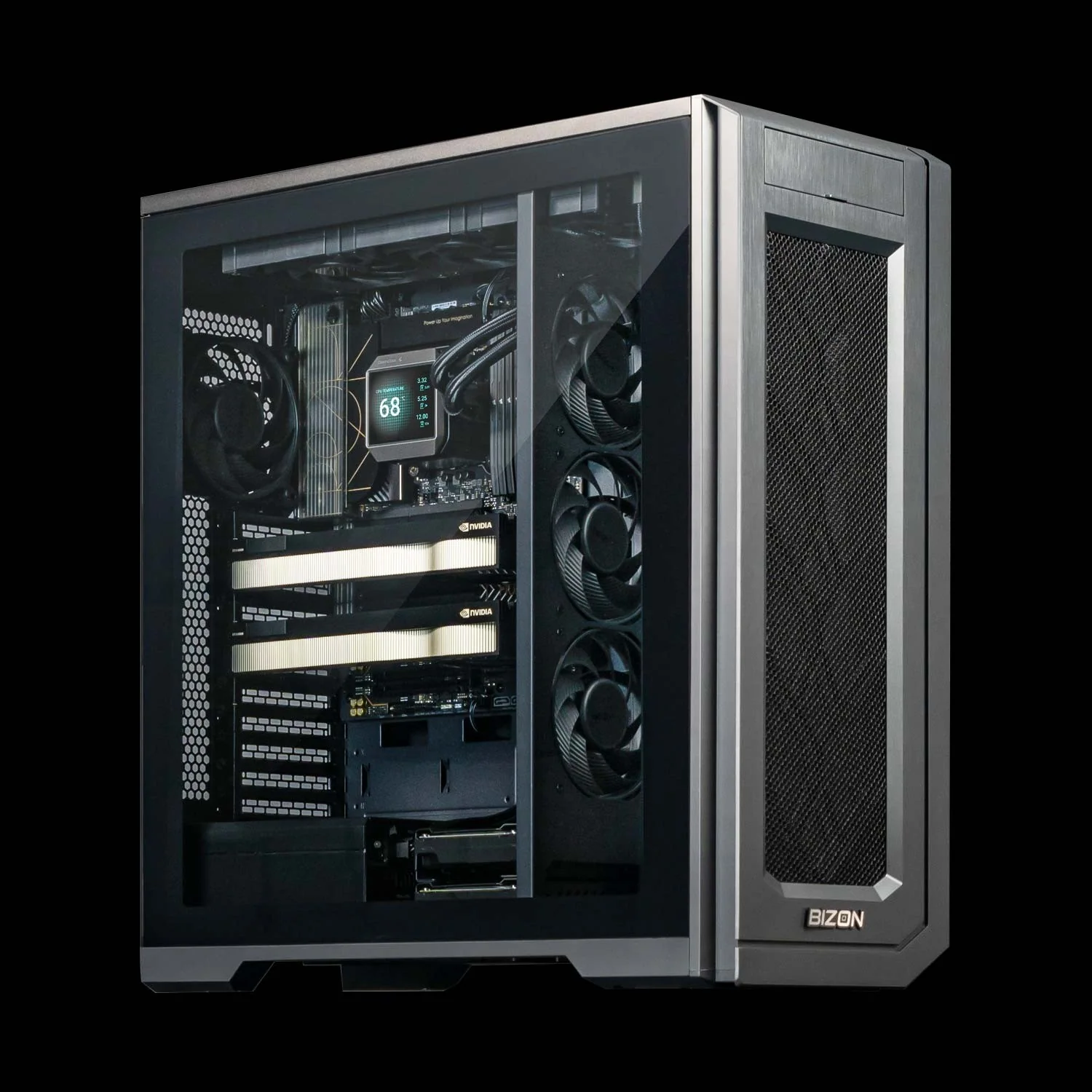
BIZON X3000 G2 Desktop Workstation
- Best for: cuDF acceleration, EDA, classical ML training, local LLM inference
- GPUs: Up to two GPUs. Compatible with the full RTX Blackwell and Ada workstation lineup
- VRAM: Up to 192 GB total (two RTX PRO 6000 at 96 GB ECC each)
- CPU: AMD Ryzen 9000 Series
- RAM: Up to 256 GB DDR5, dual-channel
- Connectivity: 1 GbE built-in plus Wi-Fi/Bluetooth, up to 25 GbE (Dual-Port SFP28).
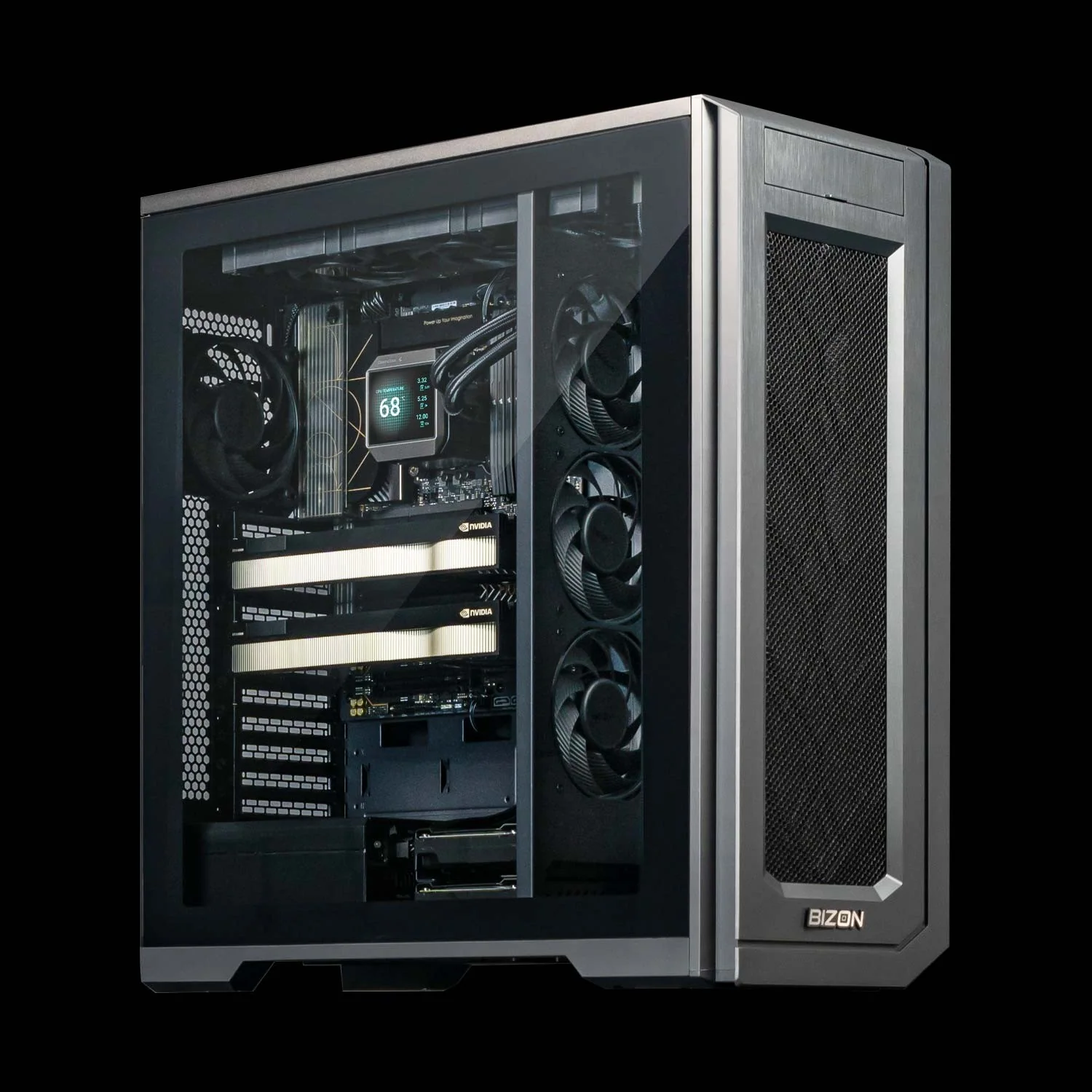
BIZON V3000 G4 Desktop Workstation
- Best for: cuDF acceleration, EDA, small-to-mid dataset processing
- GPUs: Up to two GPUs. Compatible with the full RTX Blackwell and Ada workstation lineup
- VRAM: Up to 192 GB total (two RTX PRO 6000 at 96 GB ECC each)
- CPU: Intel Core Ultra Series
- RAM: Up to 192 GB DDR5, dual-channel
- Connectivity: 1 GbE built-in plus Wi-Fi/Bluetooth, up to 25 GbE (Dual-Port SFP28).
Professional Tier (2-4 GPU)
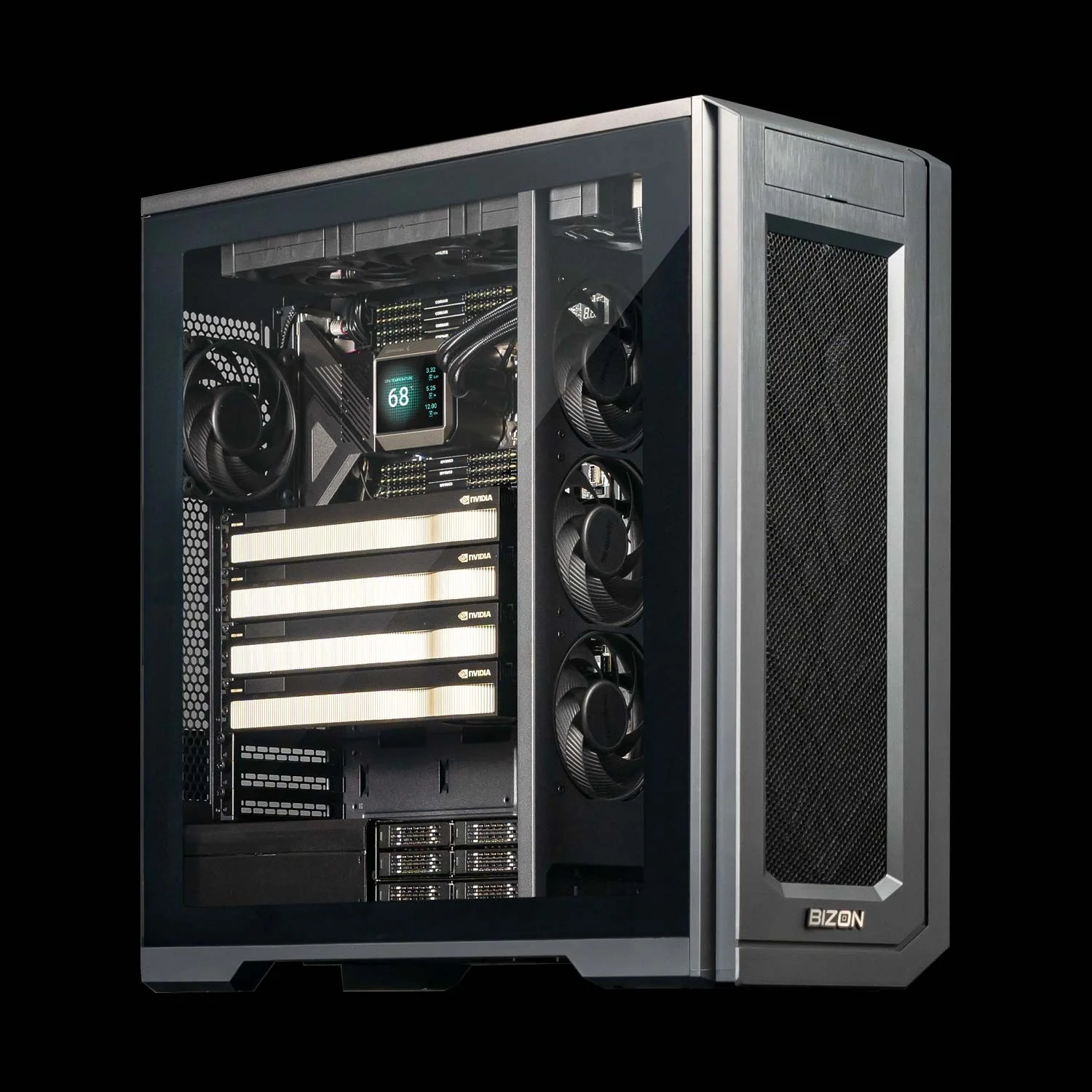
BIZON G3000 Gen2 Desktop Workstation
- Best for: Large-scale cuDF, production cuML pipelines, Dask-cuDF distributed processing
- GPUs: Up to four GPUs. Compatible with the full RTX Blackwell and Ada workstation lineup
- VRAM: Up to 384 GB total (four RTX PRO 6000 at 96 GB ECC each)
- CPU: Intel Xeon W-3500 / W-2500
- RAM: Up to 1,024 GB DDR5 ECC Buffered, quad-channel
- Connectivity: 1 GbE built-in plus Wi-Fi/Bluetooth, up to 100 Gbps InfiniBand EDR (Mellanox ConnectX).
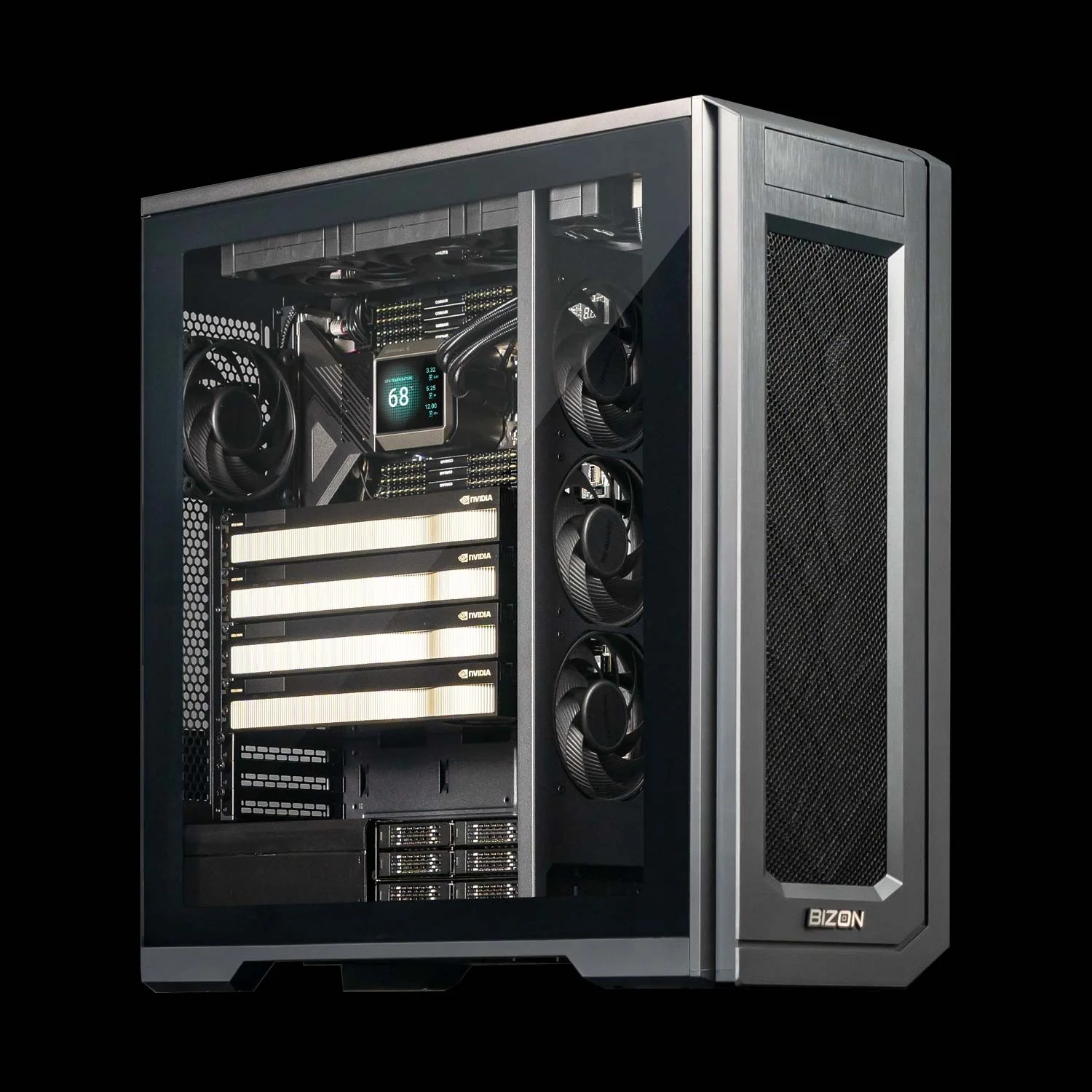
BIZON X5500 G2 Desktop Workstation
- Best for: Mixed data science and ML training, multi-model experiments
- GPUs: Up to four GPUs. Compatible with the full RTX Blackwell and Ada workstation lineup
- VRAM: Up to 384 GB total (four RTX PRO 6000 at 96 GB ECC each)
- CPU: AMD Threadripper PRO
- RAM: Up to 1,024 GB DDR5 ECC, 8-channel
- Connectivity: 1 GbE built-in plus Wi-Fi/Bluetooth, up to 200 Gbps InfiniBand HDR (Mellanox ConnectX-6).
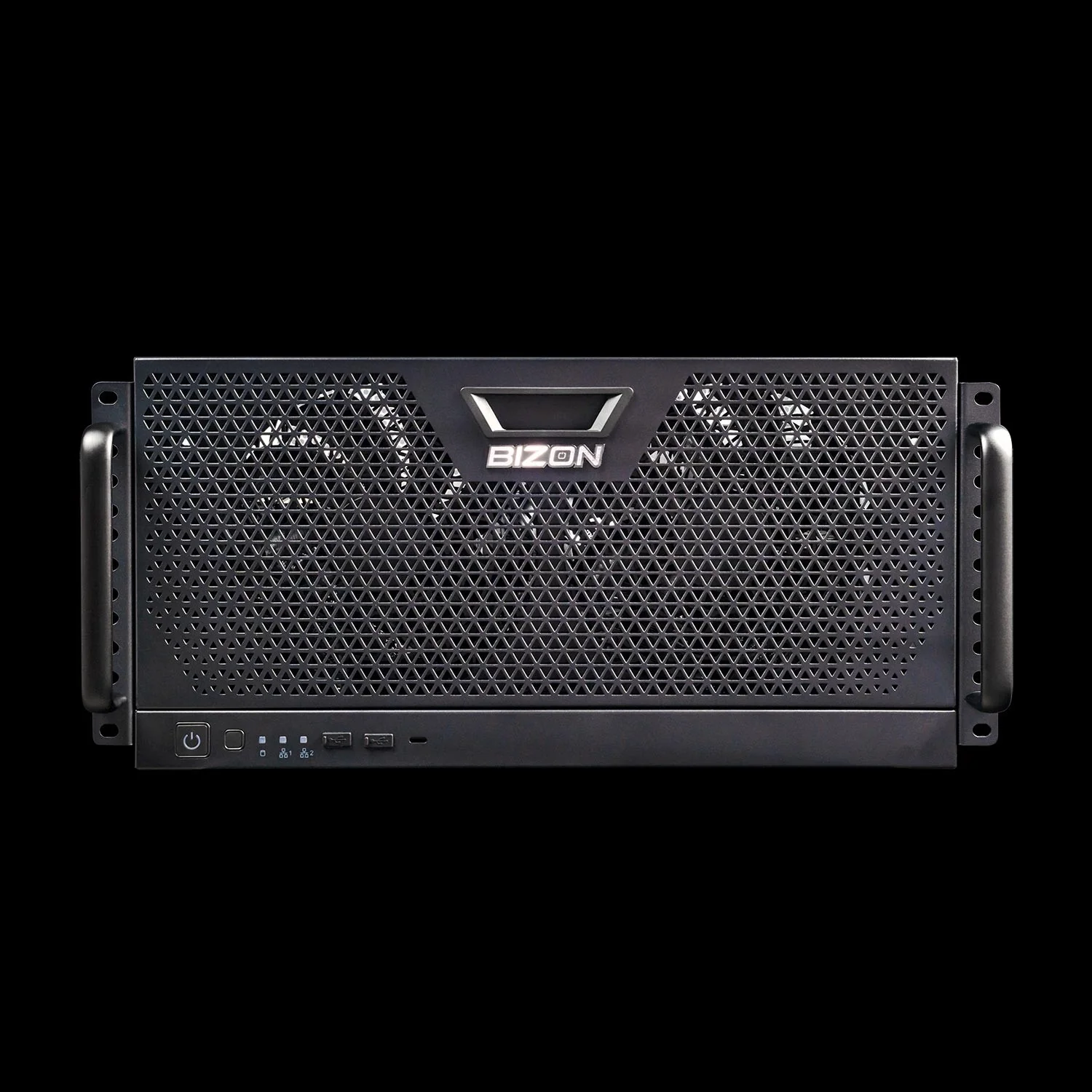
BIZON R5000 Rackmount Workstation
- Best for: Production batch processing, multi-GPU RAPIDS, shared team resource
- GPUs: Up to four GPUs. Compatible with the full RTX Blackwell and Ada workstation lineup
- VRAM: Up to 384 GB total (four RTX PRO 6000 at 96 GB ECC each)
- CPU: AMD Threadripper PRO
- RAM: Up to 1,024 GB DDR5 ECC, 8-channel
- Connectivity: 1 GbE built-in plus Wi-Fi/Bluetooth, up to 100 Gbps InfiniBand EDR (Mellanox ConnectX).
Enterprise Tier (8 GPU)
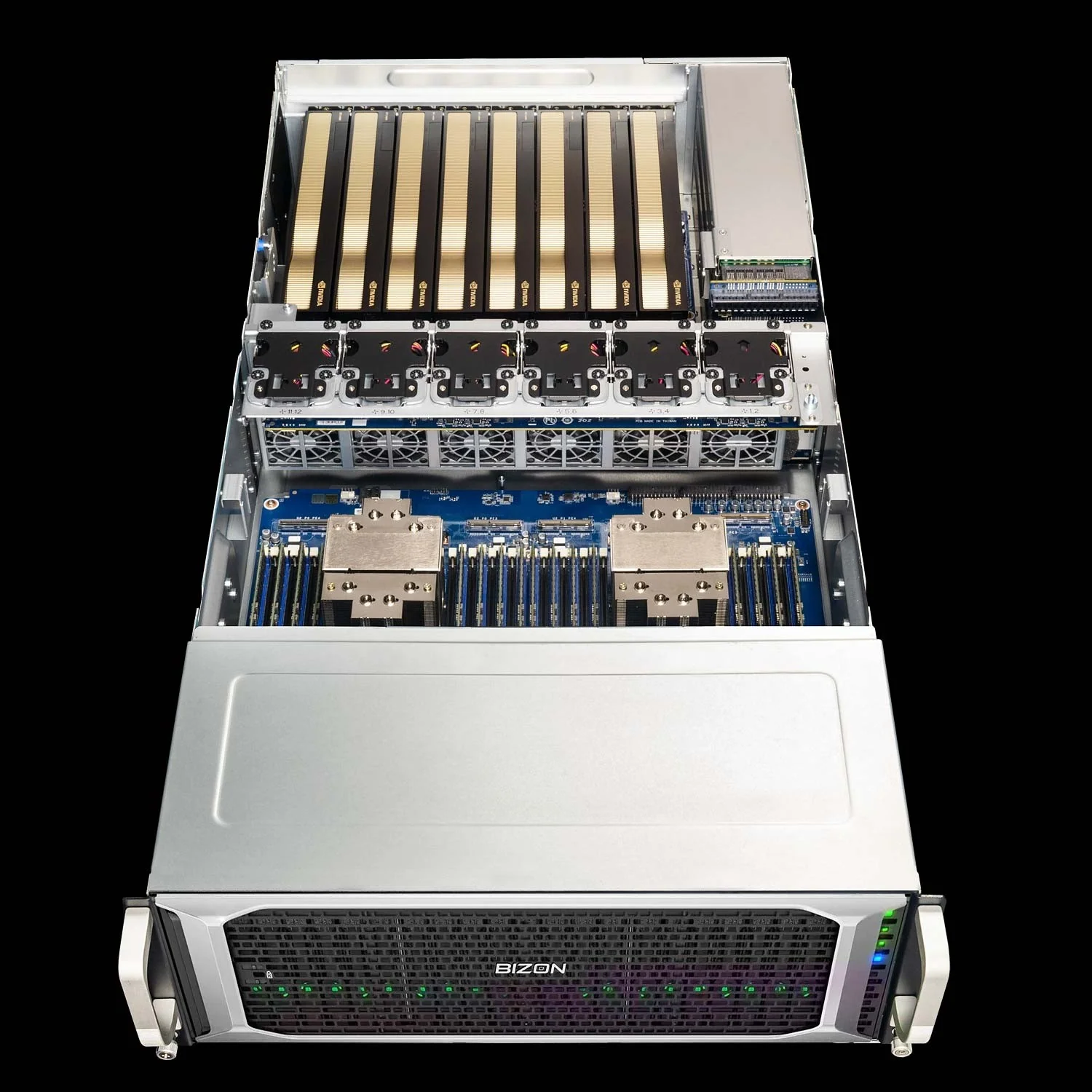
BIZON X7000 G3 Rackmount Server
- Best for: Maximum GPU density, petabyte-scale data processing
- GPUs: Up to eight GPUs. Supports RTX A1000, RTX 6000 Ada, RTX PRO 4000/4500/5000/6000, L40s, A100 80GB, H100 94GB NVL, H200 141GB NVL
- VRAM: Up to 1,128 GB total (eight H200 at 141 GB HBM3e each)
- CPU: Dual AMD EPYC 9004/9005
- RAM: Up to 3,072 GB DDR5 ECC Buffered, 12-channel per CPU
- Connectivity: 10 GbE dual port (two RJ45) integrated, up to 400 Gbps InfiniBand NDR (Mellanox ConnectX-7), NVLink Bridge available for paired GPUs.
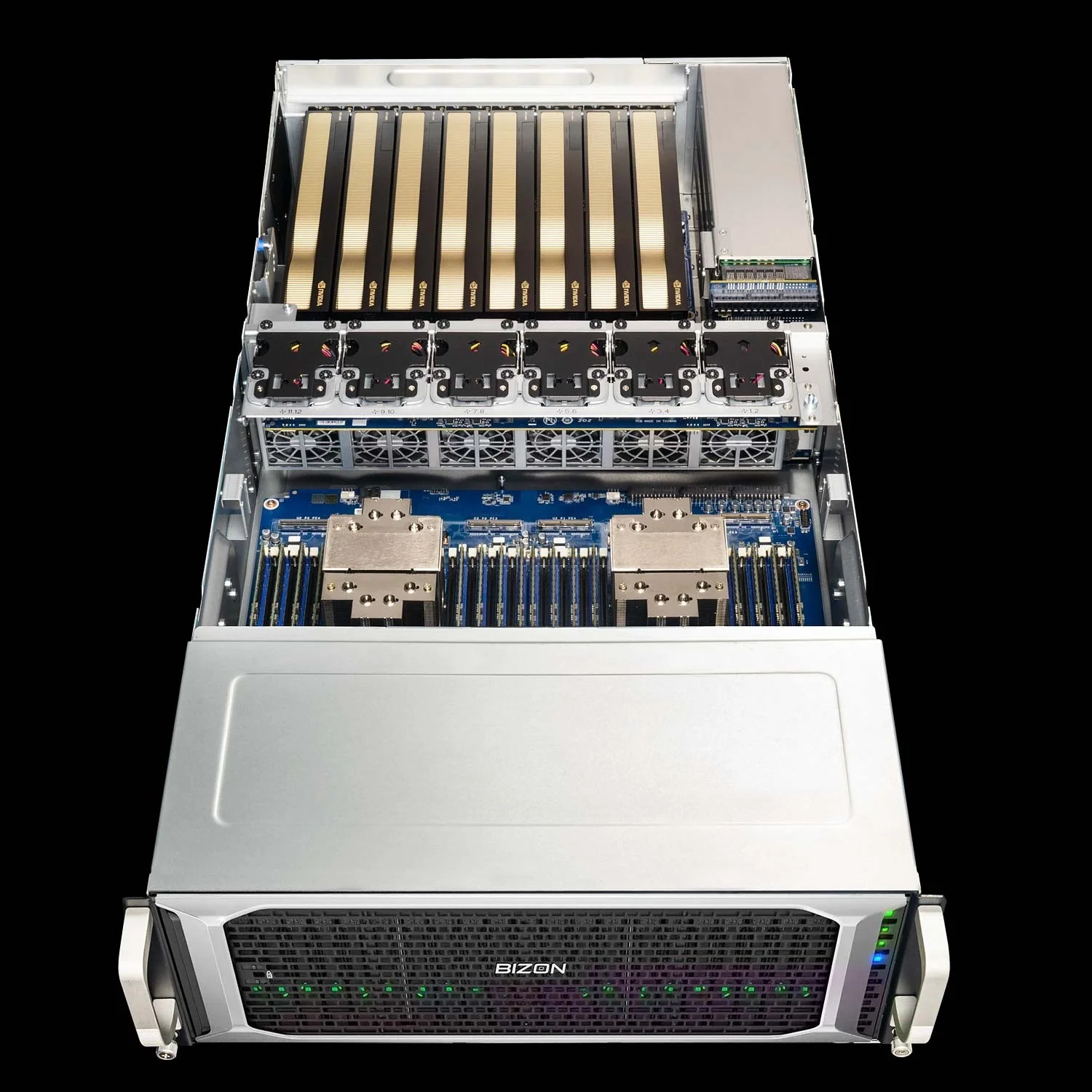
BIZON G9000 Gen 2 Rackmount Server
- Best for: 8-GPU NVLink data science clusters with Hopper-class HBM bandwidth
- GPUs: Up to eight GPUs. Supports A100 40/80GB, H100 94GB NVL, H200 141GB NVL
- VRAM: Up to 1,128 GB total (eight H200 at 141 GB HBM3e each)
- CPU: Dual AMD EPYC 9004/9005 or dual Intel Xeon Scalable 4th/5th Gen
- RAM: Up to 6,144 GB (AMD) or 8,192 GB (Intel) DDR5 ECC, 12-channel (AMD) or 8-channel (Intel)
- Connectivity: 10 GbE dual port (two RJ45) integrated, up to 400 Gbps InfiniBand NDR (Mellanox ConnectX-7).
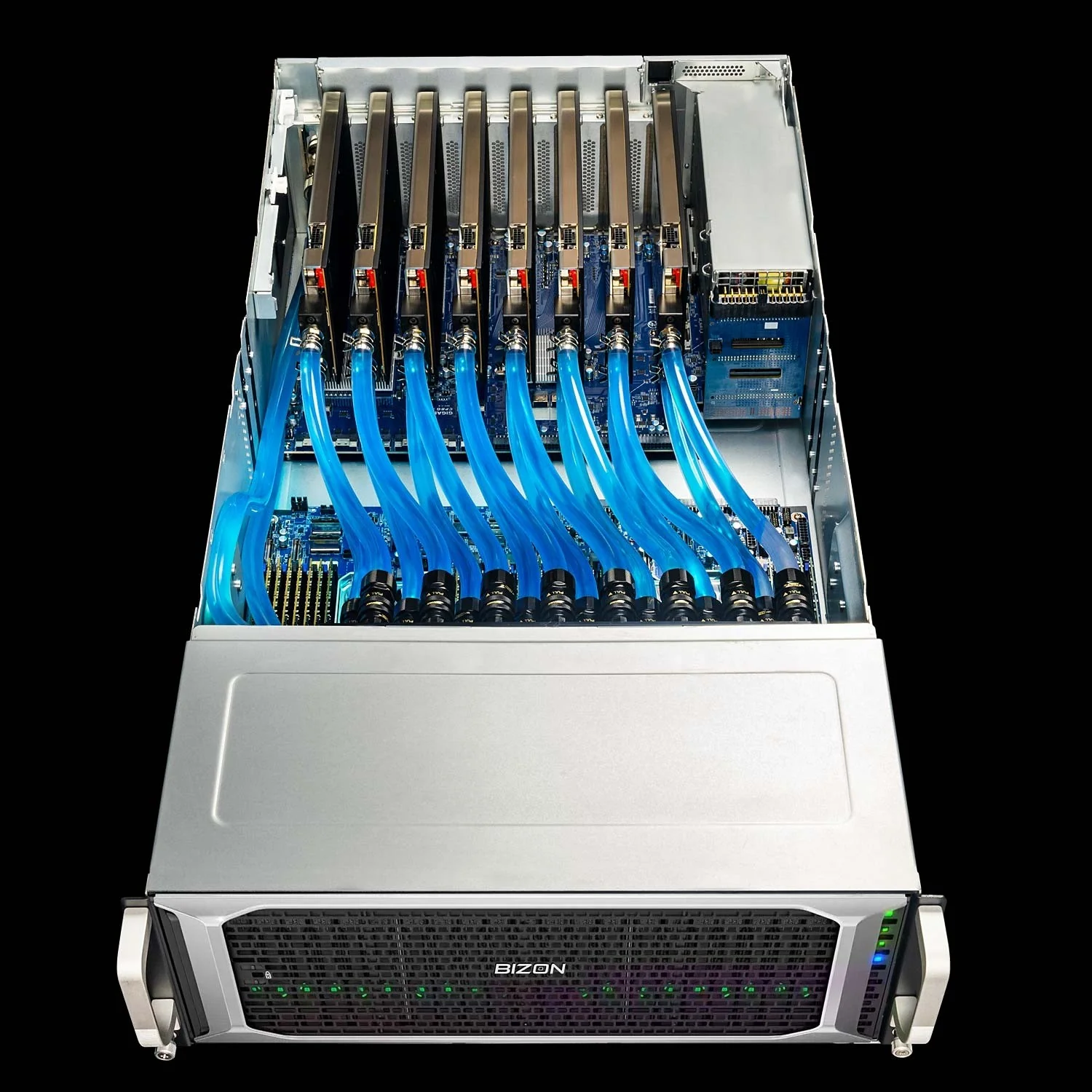
BIZON ZX9000 Water-Cooled Rackmount Server
- Best for: Sustained 8-GPU production data science where air-cooled chassis throttle
- GPUs: Up to eight water-cooled GPUs. Supports RTX A1000, RTX 6000 Ada, RTX PRO 6000 Blackwell, A100 80GB, H100 94GB NVL, H200 141GB NVL
- VRAM: Up to 1,128 GB total (eight H200 at 141 GB HBM3e each)
- CPU: Dual AMD EPYC 9004/9005
- RAM: Up to 3,072 GB DDR5 ECC Buffered, 12-channel per CPU
- Connectivity: 10 GbE dual port (two RJ45) integrated, up to 400 Gbps InfiniBand NDR (Mellanox ConnectX-7).
Picking Your Data Science GPU
Memory beats compute for data science. The cuDF and cuML stack delivers roughly 100x speedups on tabular work with one import line, since GPU memory carries the heavy lifting on big-table operations where pandas cores lag. VRAM capacity and ECC define most GPU selection decisions, not TFLOPS. Get the VRAM right and the speedup follows from the library, not the silicon brand.
Most professionals under 32 GB land on the RTX 5090 in an X3000 G2 or V3000 G4. Teams with ECC or larger datasets step up to the RTX PRO 6000 in the G3000 Gen2 or X5500 G2. ECC is the dividing line. Enterprise pipelines on 200 GB-plus datasets run on the H200 NVL in the X7000 G3, where HBM3e bandwidth carries distributed RAPIDS the rest of the way. Every BIZON configuration ships with the RAPIDS stack pre-installed, matched to the GPU and tested before it leaves the build floor.
The 10-minute pandas wait does not have to be part of the job. Stop waiting and start spec'ing. Browse data science workstations or see the LLM GPU pillar for the deep-learning side of the same decision. Each tier ships with the RAPIDS-ready stack, ECC across the professional and enterprise rows, and the warranty that backs production data work.
BIZON manufactures the workstations and servers discussed in this article. Benchmark figures and product specifications reflect published vendor sources (NVIDIA RAPIDS release notes, official NVIDIA datasheets) and BIZON build-floor experience. Our editorial recommendations follow the engine-first, workload-first analysis shown above. They are not constrained by inventory or commercial considerations.